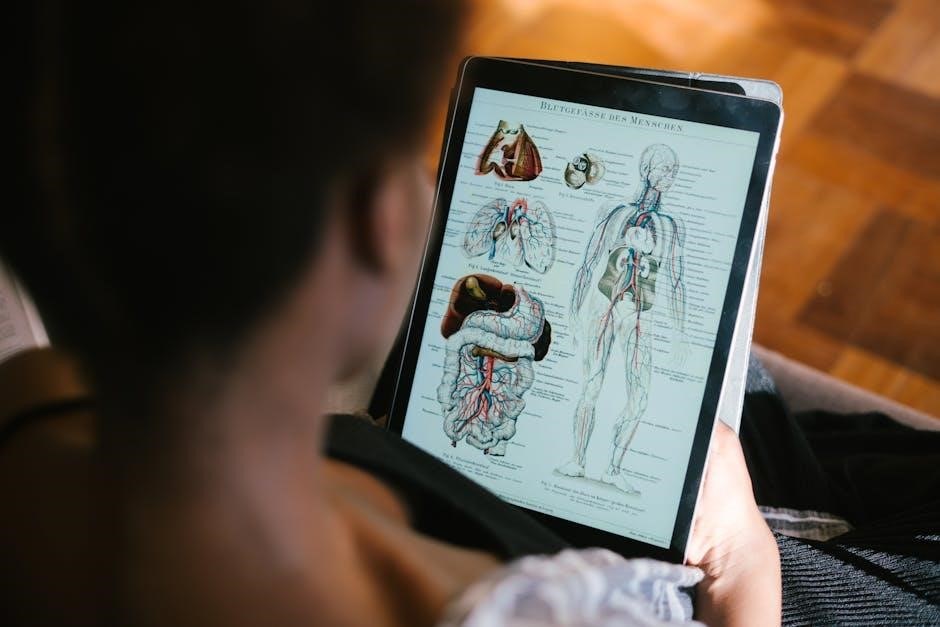
anatomy and physiology study guides
- Published
- in Guide
Anatomy and Physiology Study Guides: A Comprehensive Plan
Anatomy and physiology explore the body’s structure and function; effective study guides are crucial for mastering these interconnected, complex biological sciences.
Anatomy and physiology are foundational biological sciences, intrinsically linked in understanding life. Anatomy meticulously details the body’s structures – organs, tissues, and cells – while physiology investigates their functions and processes. This dynamic duo reveals how the body is built and how it operates.
Studying these disciplines requires a systematic approach, as complexity increases with each level of organization. Comprehending both structure and function is vital for healthcare professionals and anyone seeking a deeper understanding of the human body. Effective study habits are paramount for success.

II. Why Use Study Guides?
Anatomy and physiology present a vast amount of information, making study guides indispensable tools. They condense complex concepts into manageable formats, enhancing comprehension and retention. Well-structured guides facilitate focused learning, pinpointing key structures and functions.
Study guides actively engage learners, promoting self-assessment and identifying knowledge gaps. They move beyond passive reading, encouraging critical thinking and application of concepts. Ultimately, utilizing study guides improves exam performance and fosters a deeper, lasting understanding of the body’s intricate systems.
III. Core Concepts in Anatomy
Anatomy, the study of structure, relies on foundational concepts for understanding the body. Grasping anatomical terminology – directional terms, body planes, and regional names – is paramount for precise communication. Equally vital is understanding the levels of structural organization, from chemical to organismal levels.
These levels demonstrate how simple structures build into complex systems. Mastering these core concepts provides a framework for learning specific anatomical details, enabling students to visualize and comprehend the body’s intricate design.
III.A. Anatomical Terminology
Anatomical terminology provides a standardized vocabulary for describing body structures and their relationships. Key terms include directional descriptors like superior/inferior, anterior/posterior, and medial/lateral. Understanding body planes – sagittal, frontal, and transverse – is crucial for visualizing anatomical sections.
Regional terms, denoting specific body areas (e.g., cephalic, brachial), further refine descriptions. Consistent use of this terminology ensures clear and unambiguous communication within the field, forming the bedrock of anatomical study.
III.B. Levels of Structural Organization
Structural organization in the body progresses through six levels: chemical, cellular, tissue, organ, system, and organismal. Chemical level involves atoms and molecules. Cells, the basic units of life, build tissues – groups of similar cells performing specific functions. Organs comprise different tissues working together, and organ systems consist of cooperating organs.
Ultimately, these systems integrate to form the complete organism. Understanding this hierarchical arrangement is fundamental to grasping how the body functions as a cohesive whole, linking anatomy and physiology.
IV. Core Concepts in Physiology

Physiology delves into the functions of living organisms, examining processes from cellular activity to systemic integration. It’s a dynamic science, focusing on how organisms maintain internal stability – a concept known as homeostasis. Understanding physiological principles requires grasping how organs and systems interact to achieve coordinated function.
This includes studying biological compounds and their roles, alongside the mechanisms governing normal bodily operations. Physiology builds upon anatomical foundations, explaining how structures work.
IV.A. Homeostasis and Feedback Mechanisms
Homeostasis, the body’s ability to maintain a stable internal environment, is central to physiology. This isn’t a static state, but a dynamic equilibrium achieved through intricate feedback mechanisms. Negative feedback loops counteract changes, like temperature regulation, while positive feedback amplifies them, such as childbirth.
Understanding these mechanisms – involving sensors, control centers, and effectors – is vital. Disruptions to homeostasis lead to illness, highlighting its importance in normal function and overall health;
IV.B. Basic Cell Physiology
Basic cell physiology forms the foundation of understanding how tissues and organs function. Cells, the fundamental units of life, perform processes like membrane transport (diffusion, osmosis), cellular respiration (ATP production), and protein synthesis.
These processes rely on the cell’s structure – nucleus, cytoplasm, organelles – and their interactions. Studying cell communication, including signaling pathways, is also crucial. Comprehending these basics unlocks understanding of complex physiological systems throughout the body.
V. Study Guides for Specific Body Systems — Overview
Dedicated study guides tailored to each body system – skeletal, muscular, nervous, cardiovascular, respiratory, digestive, urinary, endocrine, and reproductive – are essential. Each guide should focus on the unique anatomy and physiology of that system.
Effective guides will integrate diagrams, clinical correlations, and practice questions. A systemic approach, building from foundational concepts to complex interactions, enhances learning. Prioritize understanding how systems work together, not just memorizing facts.
VI. Skeletal System Study Guide
The skeletal system guide should begin with bone structure – compact, spongy, and marrow – and their functions: support, protection, and movement. Explore bone cell types (osteoblasts, osteocytes, osteoclasts) and bone remodeling processes.
Detailed diagrams illustrating different bone classifications (long, short, flat, irregular) are vital. Focus on key skeletal features and landmarks. Understanding bone growth, fracture repair, and common skeletal disorders is also crucial for comprehensive learning.
VI.A. Bone Structure and Function
Bone structure encompasses both microscopic and macroscopic features. Microscopically, understand compact and spongy bone, osteons, and canaliculi. Macroscopically, identify bone markings like processes, foramina, and fossae.
Bone functions are diverse: support for the body, protection of vital organs, facilitating movement with muscles, mineral storage (calcium, phosphate), and blood cell formation (hematopoiesis) within bone marrow. Study guides should emphasize the relationship between structure and these essential functions.
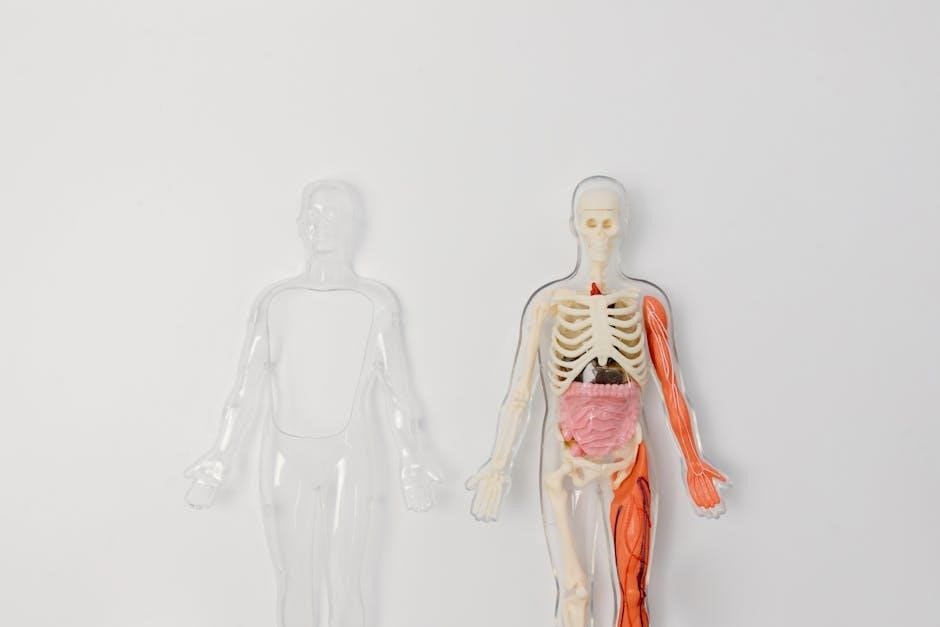
VI.B. Types of Joints
Joints, where bones meet, are classified structurally and functionally. Structurally, they are fibrous, cartilaginous, or synovial. Functionally, they range from immovable (synarthrosis) to slightly movable (amphiarthrosis) and freely movable (diarthrosis).
Synovial joints – ball-and-socket, hinge, pivot, saddle, plane, and condyloid – require detailed study. Study guides should illustrate joint movements (flexion, extension, abduction, adduction, rotation) and relate them to specific joint types and anatomical structures. Understanding stability versus mobility is key.
VII. Muscular System Study Guide
The muscular system enables movement, maintains posture, and generates heat. Study guides should focus on muscle anatomy – from gross structures to microscopic features. Key areas include muscle fiber types (skeletal, smooth, cardiac), their unique characteristics, and locations within the body.
Understanding muscle attachments (origin, insertion) and lever systems is vital. Diagrams illustrating these concepts are incredibly helpful. Guides should also cover muscle naming conventions and the functional groupings of muscles – agonists, antagonists, synergists.
VII.A. Muscle Tissue Types
Muscle tissue is categorized into three distinct types: skeletal, smooth, and cardiac. Skeletal muscle, responsible for voluntary movements, exhibits striations and is attached to bones. Smooth muscle, found in organ walls, controls involuntary functions like digestion and lacks striations.

Cardiac muscle, exclusive to the heart, is also striated but operates involuntarily, possessing unique intercalated discs for coordinated contractions. Study guides should detail the microscopic structure of each type – fiber shape, nuclei location, and presence/absence of striations – alongside their specific functions and control mechanisms.
VII.B. Muscle Contraction Process
Muscle contraction is a complex process initiated by nerve impulses triggering the release of calcium ions. These ions bind to troponin, exposing myosin-binding sites on actin filaments. Myosin heads then attach, forming cross-bridges and pulling actin filaments closer, shortening the sarcomere.
This “sliding filament theory” requires ATP for both attachment and detachment. Study guides should emphasize the roles of actin, myosin, calcium, and ATP, detailing the steps from nerve impulse to muscle shortening, and the importance of neuromuscular junctions.
VIII. Nervous System Study Guide
The nervous system, controlling bodily functions, demands a focused study approach. Guides should prioritize understanding the central and peripheral nervous systems, including the brain, spinal cord, and nerves. Key areas include neuron structure – dendrites, axons, synapses – and signal transmission via action potentials.
Effective guides will detail neurotransmitters, brain regions, and reflexes. Diagrams illustrating neural pathways are invaluable. Mastering this system requires linking structure to function, and understanding how signals coordinate responses.
VIII.A. Neuron Structure and Function
Neurons, the fundamental units of the nervous system, require detailed study. Guides should clearly illustrate the cell body (soma), dendrites receiving signals, and the axon transmitting them. Myelin sheaths and nodes of Ranvier are crucial for understanding signal speed.
Focus on synaptic transmission – how signals jump between neurons via neurotransmitters. Understanding resting membrane potential and action potentials is vital. Diagrams labeling each component, coupled with functional explanations, will enhance comprehension of neuronal communication.
VIII.B. Brain Regions and Their Functions
Brain study guides must systematically cover major regions. Begin with the cerebrum – its lobes (frontal, parietal, temporal, occipital) and associated functions like motor control, sensation, and memory. The cerebellum’s role in coordination and balance deserves emphasis.
Don’t neglect the brainstem (midbrain, pons, medulla oblongata) controlling vital functions. Include the limbic system (amygdala, hippocampus) for emotion and memory. Diagrams highlighting each region, alongside concise function summaries, are essential for effective learning and recall.
IX. Cardiovascular System Study Guide
Cardiovascular study guides should prioritize understanding the heart’s anatomy – chambers, valves, and major vessels. Trace blood flow meticulously, detailing the pulmonary and systemic circuits. Focus on the cardiac cycle: systole, diastole, and their regulation.
Explore blood vessel structure (arteries, veins, capillaries) and their roles in circulation. Include blood pressure regulation and factors influencing cardiac output. Diagrams illustrating blood flow and vessel types are invaluable. Understanding these concepts builds a strong foundation for advanced physiology.
IX.A. Heart Anatomy and Cardiac Cycle
Heart anatomy guides must detail the four chambers – atria and ventricles – and their respective functions. Thoroughly examine valve structures (tricuspid, mitral, pulmonary, aortic) and their roles in unidirectional blood flow. Study the layers of the heart wall: epicardium, myocardium, and endocardium.
The cardiac cycle requires understanding systole (contraction) and diastole (relaxation). Explore the sequence of events – atrial contraction, ventricular contraction, and relaxation – alongside associated heart sounds. Diagrams illustrating these phases are essential for visualization and comprehension.
IX.B. Blood Vessels and Circulation
Circulation study guides should comprehensively cover arteries, veins, and capillaries – detailing their structural differences and functional roles. Trace the systemic and pulmonary circuits, understanding blood flow pathways. Explore the concept of blood pressure, resistance, and factors influencing circulation.
Focus on the major arteries and veins (aorta, vena cava, pulmonary artery/vein) and their branching patterns. Diagrams illustrating the circulatory system are vital. Understand how blood vessel diameter impacts blood flow and the role of the nervous system in regulating circulation.
X. Respiratory System Study Guide
Respiratory system guides must detail the pathway of air, from nasal passages to the alveoli. Focus on the anatomy of the lungs, bronchi, and diaphragm, understanding their roles in ventilation. Explore the mechanics of breathing – inspiration and expiration – and the muscles involved.
Crucially, cover gas exchange: oxygen and carbon dioxide diffusion. Study guides should also address lung volumes and capacities, and the regulation of respiration by the nervous system. Diagrams illustrating airflow and gas exchange are essential for comprehension.
X.A. Lung Anatomy and Gas Exchange
Lung anatomy study requires detailed knowledge of lobes, pleura, and bronchioles. Trace the airway from the trachea, branching into smaller and smaller passages. Understand the structure of alveoli – the site of gas exchange – and their rich capillary network.
Gas exchange focuses on diffusion: oxygen moving into the blood, carbon dioxide out. Study guides should illustrate partial pressure gradients and hemoglobin’s role. Explore factors affecting gas exchange, like surface area and membrane thickness, for a complete understanding.
X.B. Breathing Mechanics

Breathing mechanics involve understanding inspiration and expiration. Study guides should detail the roles of the diaphragm and intercostal muscles in increasing and decreasing thoracic volume. Focus on Boyle’s Law – the relationship between pressure and volume – as it applies to lung function.
Explore lung compliance and airway resistance, factors impacting ease of breathing. Differentiate between tidal volume, vital capacity, and residual volume. Visual aids demonstrating pressure changes during the respiratory cycle are invaluable for mastering these concepts.
XI. Digestive System Study Guide
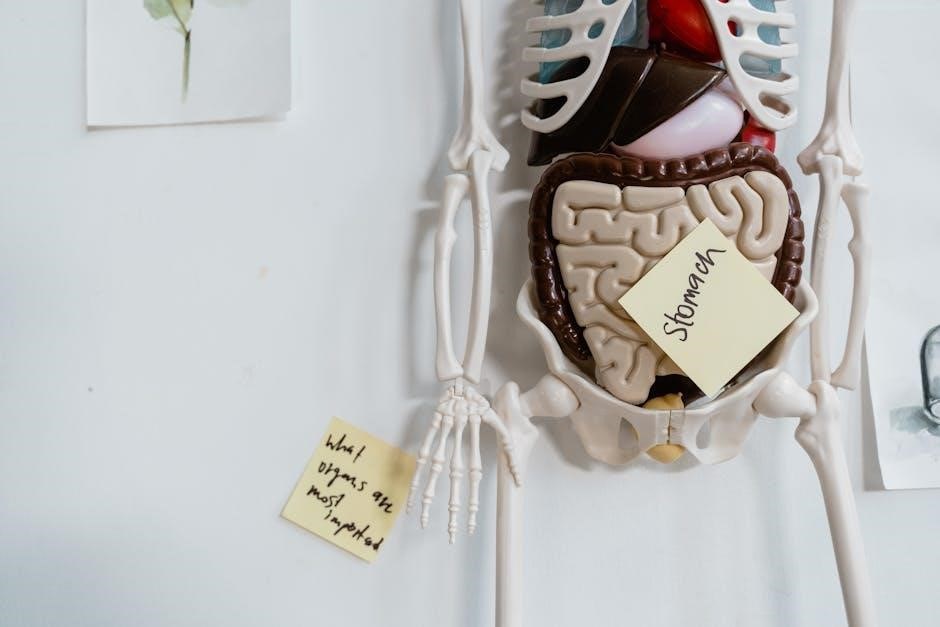
The digestive system study guide should begin with a detailed overview of each organ – mouth, esophagus, stomach, small and large intestines – and their specific functions in breaking down food. Emphasize the roles of enzymes like amylase, protease, and lipase in chemical digestion.
Include sections on peristalsis and segmentation, the mechanical processes aiding food movement. Focus on the unique absorptive features of the small intestine (villi and microvilli). Understanding accessory organs – liver, gallbladder, and pancreas – is also crucial for complete comprehension.
XI.A. Digestive Organs and Their Functions
This section details each organ’s role: the mouth initiates mechanical & chemical breakdown; the esophagus transports food; the stomach churns and mixes with gastric juices. The small intestine is where most nutrient absorption occurs, aided by the duodenum, jejunum, and ileum.
The large intestine absorbs water and forms feces. Accessory organs – the liver producing bile, the gallbladder storing it, and the pancreas secreting enzymes – are vital. Study guides should include diagrams labeling each organ and clearly outlining their sequential functions in digestion.

XI.B. Nutrient Absorption
Effective study guides must emphasize how nutrients are absorbed within the small intestine. Villi and microvilli dramatically increase surface area for efficient uptake of carbohydrates, proteins, and fats. Different mechanisms – active transport, facilitated diffusion, and simple diffusion – are employed.
Water-soluble nutrients enter the bloodstream directly, while fats are absorbed into lacteals, part of the lymphatic system. Understanding these processes, and the roles of specific transporters, is key. Diagrams illustrating absorption pathways are invaluable study tools.
XII. Urinary System Study Guide
A comprehensive study guide for the urinary system should detail kidney structure – nephrons, glomeruli, and tubules – and their functions in filtration, reabsorption, and secretion. Trace the path of urine from the kidneys through the ureters, bladder, and urethra.
Focus on hormonal control of kidney function, like ADH and aldosterone, and their impact on fluid and electrolyte balance. Understanding common pathologies, such as UTIs and kidney failure, enhances comprehension. Diagrams illustrating nephron function are essential.
XIII. Endocrine System Study Guide
An effective endocrine system guide must cover major glands – pituitary, thyroid, adrenal, pancreas, ovaries/testes – and the hormones they produce. Detail hormone mechanisms of action: receptor binding, signal transduction, and cellular effects.
Emphasize negative and positive feedback loops regulating hormone secretion. Include disorders caused by hormone imbalances, like diabetes or hyperthyroidism. Charts comparing hormone types (steroid, protein, amine) and their solubility are beneficial. Diagrams illustrating hormone pathways are crucial for understanding.
XIV. Reproductive System Study Guide
A comprehensive reproductive system study guide should differentiate between male and female anatomy, detailing organs like testes, ovaries, uterus, and associated ducts. Focus on gametogenesis – spermatogenesis and oogenesis – including meiosis and hormonal control.
Explain the menstrual cycle phases and hormonal fluctuations. Include fertilization, implantation, and embryonic development basics. Diagrams illustrating reproductive structures and hormonal feedback loops are essential. Discuss common reproductive disorders and related physiological processes.
XV. Types of Anatomy Study Guides
Anatomy study guides vary in format to suit different learning styles. Flashcard-based guides excel at memorizing structures and terms, ideal for quick recall. Diagram-based guides visually represent anatomical relationships, enhancing spatial understanding.
Coloring books reinforce structure recognition. Interactive digital guides offer 3D models and quizzes. Regional anatomy guides focus on specific body areas, while systemic guides cover systems as a whole. Choose guides aligning with your course and preferred learning method for optimal results.
XV.A. Flashcard-Based Guides
Flashcard-based anatomy guides are a classic, highly effective study tool. They facilitate active recall, crucial for memorizing anatomical structures, origins, insertions, and functions. Creating your own cards reinforces learning, while pre-made sets offer convenience.
Focus on one concept per card – a bone, muscle, or nerve – and include diagrams. Regularly reviewing cards, utilizing spaced repetition, maximizes retention. Digital flashcard apps offer portability and features like self-testing and progress tracking, enhancing the learning experience.
XV.B. Diagram-Based Guides
Diagram-based study guides excel at visualizing complex anatomical relationships. Labeling diagrams of organs, systems, and tissues solidifies spatial understanding. These guides are particularly useful for grasping intricate structures like the heart or brain, where precise location matters.
Color-coding and detailed annotations enhance comprehension. Interactive digital diagrams allow for layered learning, revealing structures progressively. Combining diagrams with concise functional notes bridges anatomy and physiology, fostering a holistic understanding of the body’s design and operation.
XVI. Types of Physiology Study Guides
Physiology study guides often focus on processes rather than structures. Flowcharts are invaluable for illustrating complex pathways like action potentials or hormonal regulation. Concept maps connect physiological principles, revealing interdependencies between systems. Case studies present real-world scenarios, demanding application of knowledge.
Comparative tables highlight differences in physiological responses under varying conditions. Emphasis on mechanisms – how things work – is key. These guides should encourage explaining why a process occurs, not just what happens, fostering deeper understanding.
XVII. Effective Study Techniques for A&P
Success in A&P demands active recall, not passive reading. Utilize spaced repetition – review material at increasing intervals – to solidify long-term memory. Teach the concepts to someone else; explaining reinforces understanding. Integrate visual aids like diagrams and models to grasp spatial relationships.
Practice applying knowledge through problem-solving and clinical scenarios. Form study groups for collaborative learning and peer teaching. Break down large topics into manageable chunks, and consistently self-test to identify knowledge gaps.
XVIII. Online Resources for Anatomy and Physiology
Numerous online platforms enhance A&P learning. Visible Body offers interactive 3D models, while Khan Academy provides free video tutorials covering core concepts. GetBodySmart delivers detailed anatomical illustrations and explanations. University websites often host practice quizzes and lecture notes.
Quizlet and Anki are excellent for creating and utilizing flashcards. Explore virtual labs for physiological experiments. Remember to critically evaluate source credibility and supplement online resources with textbooks and class materials for a comprehensive understanding.
XIX. Common Pitfalls to Avoid When Studying A&P
A frequent mistake is rote memorization without understanding the underlying principles. Avoid neglecting physiology while focusing solely on anatomy, as they are intrinsically linked. Don’t underestimate the importance of practice questions and active recall.
Procrastination and attempting to cram before exams are detrimental. Ignoring foundational concepts will hinder comprehension of more complex topics. Finally, failing to utilize diverse study methods – diagrams, flashcards, and practice labs – limits learning effectiveness.
XX. Creating Your Own Study Guides
Personalized study guides enhance learning by tailoring content to your needs. Start by outlining key concepts from lectures and textbooks. Utilize diagrams and flowcharts to visualize complex processes. Include practice questions with detailed answers for self-assessment.
Focus on actively summarizing information in your own words, rather than simply copying. Regularly review and update your guides as you progress. Collaboration with peers can offer diverse perspectives and improve comprehension. A well-crafted guide becomes an invaluable resource.
XXI. Utilizing Mnemonics in A&P Study
Mnemonics are powerful memory aids, especially useful in anatomy and physiology where memorization is key. Create acronyms, rhymes, or visual associations to recall complex terms and sequences. For example, devise a sentence where the first letter of each word represents a cranial nerve.

Employing imagery and storytelling can further strengthen mnemonic recall. Regularly practice these techniques to reinforce learning. Don’t hesitate to invent your own mnemonics – personalization boosts effectiveness!
XXII. Conclusion: Mastering Anatomy and Physiology
Successfully navigating anatomy and physiology requires dedication, strategic study habits, and utilizing diverse resources. Combining study guides, mnemonics, and online tools creates a robust learning experience. Consistent review and active recall are paramount for long-term retention.
Embrace the interconnectedness of structure and function; understanding one enhances comprehension of the other. With persistent effort and the right approach, mastering A&P is achievable and rewarding!